The culture of India refers to the religions, beliefs, customs, traditions, languages, ceremonies, arts, values and the way of life in India and its people. India's languages, religions, dance, music, architecture, food, and customs differ from place to place within the country. Its culture often labeled as an amalgamation of these diverse sub-cultures is spread all over the Indian subcontinent and traditions that are several millennia old.
Regarded by many historians as the "oldest living civilization of Earth", the Indian tradition dates back to 8000 BC, and has a continuous recorded history since the time of the Vedas, believed variously to be 3,000 to over 5,500 years ago. Several elements of India's diverse culture, such as Indian religions, yoga, and Indian cuisine, have had a profound impact across the world.
Religions and spirituality
Close-up of a statue depicting Maitreya at the Thikse Monastery in Ladakh, India. Dharmic religions, such as Hinduism and Buddhism, are indigenous to India.
Main article: Religion in India
India is the birth place of Hinduism, Buddhism, Jainism and Sikhism, collectively known as Indian religions. Indian religions, also known as Dharmic religions are a major form of world religions along with Abrahamic ones. Today, Hinduism and Buddhism are the world's third and fourth-largest religions respectively, with over 2 billion followers altogether, and possibly as many as 2.5 or 2.6 billion followers.
India is also the birthplace for the Lingayat and Ahmadiyya faiths.
India is one of the most religiously diverse nations in the world, with some of the most deeply religious societies and cultures. Religion still plays a central and definitive role in the life of many of its people.
According to a 2001 census of India, the religion of 80% of the people is Hinduism. Islam is practiced by around 13% of all Indians. The country had over 23 million Christians, over 19 million Sikhs, about 8 million Buddhists and about 4 million Jains.
Sikhism, Jainism and especially Buddhism are influential not only in India but across the world. Christianity, Zoroastrianism, Judaism, and the Bahá'í Faith are also influential but their numbers are smaller. Atheism and agnostics also have visible influence in India, along with a self-ascribed tolerance to other people.
The Hindu religion has many schools, each with their own unique views. For example, according to Yogavasistha, a spiritual text of the Advaita school of Hindu religion, the values of the liberated , self-actualized human being, may be summarized as follows:"Pleasures do not delight him; pains do not distress. Although engaged in worldly actions, he has no attachment to any object. He is busy outwardly, yet calm inwardly. He feels free from restrictions of scriptures, customs, age, caste or creed. He is happy, but his happiness does not depend on anything else. He does not feel needy, proud, agitated, troubled, depressed or elated. He is full of compassion and forgiveness even to those who mean him harm. He does the right thing, regardless of the pressures. He is patient, perseverant, and without any impurity in his heart. He is free of delusions, he does not crave for anything. His sense of freedom comes from his spirit of inquiry. The fruits of his inquiry are his strength, intellect, efficiency and punctuality. He keeps company of wise and enlightened persons. He is content."
There is significant historical discourse in India on the notion, relevance, and the existence and non-existence of God. Dharmakirti, for example, in 7th century wrote in Pramanavarttikam:
Believing that the Veda are standard (holy or divine), believing in a Creator for the world,
Bathing in holy waters for gaining punya, having pride (vanity) about one's job function,
Performing penance to absolve sins,
Are the five symptoms of having lost one's sanity.
Perceptions of Indian culture
Main article: Stereotypes of South Asians
India's diversity has inspired many writers to pen their perceptions of the country's culture. These writings paint a complex and often conflicting picture of the culture of India.
According to industry consultant Eugene M. Makar, for example, traditional Indian culture is defined by a relatively strict social hierarchy. He also mentions that from an early age, children are reminded of their roles and places in society. This is reinforced, Makar notes, by the way many believe gods and spirits have an integral and functional role in determining their life. Several differences such as religion divide the culture. However, a far more powerful division is the traditional Hindu bifurcation into non-polluting and polluting occupations. Strict social taboos have governed these groups for thousands of years, claims Makar. In recent years, particularly in cities, some of these lines have blurred and sometimes even disappeared. He writes important family relations extend as far as gotra, the mainly patrilinear lineage or clan assigned to a Hindu at birth. In rural areas & sometimes in urban areas as well, it is common that three or four generations of the family live under the same roof. The patriarch often resolves family issues.
Others have a different perception of Indian culture. According to an interview with C.K. Prahalad by Des Dearlove, author of many best selling business books, modern India is a country of very diverse cultures with many languages, religions and traditions. Children begin by coping and learning to accept and assimilate in this diversity. Prahalad - who was born in India and grew up there - claimed, in the interview, that Indians, like everyone else in the world, want to be treated as unique, as individuals, want to express themselves and seek innovation. In another report, Nancy Lockwood of Society for Human Resource Management, the world's largest human resources association with members in 140 countries, writes that in the past two decades or so, social change in India is in dramatic contrast to the expectations from traditional Indian culture. These changes have led to Indian families giving education opportunities to girls, accepting women working outside home, pursuing a career, and opening the possibility for women to attain managerial roles in corporate India. Lockwood claims that change is slow, yet the scale of cultural change can be sensed from the fact that of India's 397 million workers, 124 million are now women. The issues in India with women empowerment are similar to those elsewhere in the world.
According to Amartya Sen, the India born Nobel Laureate in Economics, the culture of modern India is a complex blend of its historical traditions, influences from the effects of colonialism over centuries and current Western culture - both collaterally and dialectically. Sen observes that external images of India in the West often tend to emphasize the difference - real or imagined - between India and the West. There is a considerable inclination in the Western countries to distance and highlight the differences in Indian culture from the mainstream of Western traditions, rather than discover and show similarities. Western writers and media usually misses, in important ways, crucial aspects of Indian culture and traditions. The deep-seated heterogeneity of Indian traditions, in different parts of India, is neglected in these homogenized description of India. The perceptions of Indian culture, by those who weren't born and raised in India, tend to be one of at least three categories, writes Sen:
Exoticist approach: it concentrates on the wonderous aspects of the culture of India. The focus of this approach of understanding Indian culture is to present the different, the strange and as Hegel put it, "a country that has existed for millennia in the imaginations of the Europeans."
Magisterial approach: it assumes a sense of superiority and guardianhood necessary to deal with India, a country that James Mill's imperialist history thought of as grotesquely primitive culture. While great many British observers did not agree with such views of India, and some non-British ones did, it is an approach that contributes to some confusion about the culture of India.
Curatorial approach: it attempts to observe, classify and record the diversity of Indian culture in different parts of India. The curators do not look only for the strange, are not weighed by political priorities, and tend to be more free from stereotypes. The curatorial approach, nevertheless, have an inclination to see Indian culture as more special and extraordinarily interesting than it actually may be.
The curatorial approach, one inspired by systematic curiosity for the cultural diversity of India within India, is mostly absent.
Susan Bayly, in her book, observes that there is considerable dispute in India and orientalist scholars on perceived Indian culture. She acknowledges that many dispute claims of pervasiveness of caste and strict social hierarchy in modern India. Bayly notes that much of the Indian subcontinent was populated by people for whom the formal distinctions of caste and strict social hierarchies were of only limited importance in their lifestyles.
According to Rosser, an American sociologist, Americans of South Asian origins feel the Western perception of the culture of India has numerous stereotypes. Rosser notes that the discourse in much of the United States about the culture of India is rarely devoted to independent India. People quickly make sweeping and flawed metaphysical assumptions about its religion and culture, but are far more circumspect when evaluating civil society and political culture in modern India. It is as if the value of South Asia resides only in its ancient contributions to human knowledge whereas its pathetic attempts to modernize or develop are to be winked at and patronized.
Rosser conducted numerous interviews and summarized the comments. The study reports a stark contrast between Western perceptions of the culture of India, versus the direct experience of the interviewed people. For example:
"The presentation of South Asians is a standard pedagogic approach which runs quickly from the "Cradle of Civilization"—contrasting the Indus Valley with Egypt and Mesopotamia—on past the Aryans, who were somehow our ancestors— to the poverty stricken, superstitious, polytheistic, caste ridden Hindu way of life. . . and then somehow magically culminates with a eulogy of Mahatma Gandhi. A typical textbook trope presents the standard Ancient India Meets the Age of Expansion Approach with a color photo of the Taj Mahal. There may be a side bar on ahimsa or a chart of connecting circles graphically explaining samsara and reincarnation, or illustrations of the four stages of life or the Four Noble Truths. Amid the dearth of real information there may be found an entire page dedicated to a deity such as Indra or Varuna, who admittedly are rather obscure vis-à-vis the beliefs of most modern Hindus."
— A South Asian in America
Family structure and marriage
Main articles: Arranged marriage in India and Women in India
A bride during a traditional Hindu wedding ceremony in Punjab.
India's family structure, and cultural traditions within its family structure, has been a subject of numerous studies.
In India's history, and currently in certain regions, a joint family plays a significant role in the Indian culture. For generations, India has had a prevailing tradition of the joint family system. It is a system under which extended members of a family – parents, children, the children’s spouses and their offspring, etc. – live together. Usually, the oldest male member is the head in the joint Indian family system. He makes all important decisions and rules, and other family members abide by them.
In a 1966 study, Orenstein and Micklin analyzed India's population data and family structure. Their studies suggest that Indian household sizes had remained similar over 1911 to 1951 period. Thereafter, with urbanization and economic development, India has witnessed a break up of traditional joint family into more nuclear-like families.
Sinha, in his book, after summarizing the numerous sociological studies done on Indian family, notes that over the last 60 years, the cultural trend in most parts of India has been an accelerated change from joint family to nuclear families, much like population trends in other parts of the world. The traditional large joint family in India, in the 1990s, accounted for a small percent of Indian households, and on average had lower per capita household income. He finds that joint family still persists in some areas and in certain conditions, in part due to cultural traditions and in part due to practical factors.
Arranged Marriage
A bride in India.
For centuries, arranged marriages have been the tradition in Indian society though men and women have always had the choice of who they want to marry. Even today, the majority of Indians have their marriages planned by their parents and other respected family-members, with the consent of the bride and groom.
In most marriages the bride's family provide a dowry to the bride to safe guard herself and her children in the event of her husband passing prematurely.[citation needed] Historically, in most families the inheritance of family estates passed down the male line. Since 1956, Indian laws treat males and females as equal in matters of inheritance without a legal will.
Indians are increasingly using a legal will for inheritance and property succession, with about 20 percent using a legal will by 2004.
In India, the divorce rate is low — 1% compared with about 40% in the United States.
These statistics do not reflect a complete picture, though. There is a dearth of scientific surveys or studies on Indian marriages, where the perspectives of both husbands and wives were solicited in-depth. Sample surveys suggest the issues with marriages in India are similar to trends observed elsewhere in the world. The divorce rates are rising in India. Urban divorce rates are much higher. Women initiate about 80 percent of divorces in India.
"Opinion is divided over what the phenomenon means: for traditionalists the rising numbers portend the breakdown of society while, for some modernists, they speak of a healthy new empowerment for women.
Recent studies suggest that Indian culture is trending away from traditional arranged marriages. Banerji et al. surveyed 41,554 households across 33 states and union territories in India in 2005. They find that the marriage trends in India are similar to trends observed over last 40 years in China, Japan and other nations.
Fewer marriages are purely arranged without consent. The study found that majority of surveyed Indian marriages were arranged with consent. The percentage of self-arranged marriages (called love marriages in India) were also increasing, particularly in the urban parts of India. A 2006 article reported that between 10 and 20 percent of marriages in urban India were self-arranged.[34]
Greetings
Folding hands together with a smile to greet Namaste - a common cultural practice in India.
Namaste, namaskar or Namaskara or Namaskaram (Telugu, Malayalam), Vanakkam (Tamil),Nomoshkaar (Bengali), Nomoskar (Assamese) is a common spoken greeting or salutation, though becoming considered old-fashioned by some. Namaskar is considered a slightly more formal version than Namaste but both express deep respect. It is commonly used in India and Nepal by Hindus, Jains and Buddhists, and many continue to use this outside the Indian subcontinent. In Indian and Nepali culture, the word is spoken at the beginning of written or verbal communication. However, the same hands folded gesture is made usually wordlessly upon departure. Taken literally, it means "I bow to you". The word is derived from Sanskrit (namah): to bow, obeisance, reverential salutation, and respect, and (te): "to you". As explained by an Indian scholar, in literal terms Namaste refers to 'That which is of God in me bows to that which is of God in you'. In most Indian families, younger men and women are taught to seek the blessing of their elders by reverentially bowing to their elders. This custom is known as Pranāma
Other greetings include "Jai Shri Krishna", "Ram Ram", and Sat Shri Akal (Punjabi, used by followers of Sikhism), Jai Jinendra, a common greeting used across the Jain community and "Nama Shivaya".
Festivals
With India's cultural diversity, the country has more festivals than there are days in a year. With little lamps and lot of care, Karthigai festival celebrates the bond between sisters and brothers in south India. In other parts of India, Bhaiya-Dhuj and Raakhi is celebrated. Sisters wish their brothers happiness and feed them sweets, while brothers give gifts and promise to protect their sisters.
Radha and gopikas celebrating Holi, known as the "festival of colors".
A tug of war, at Pushkar Fair in Rajasthan.
Main article: Festivals in India
India, being a multi-cultural and multi-religious society, celebrates holidays and festivals of various religions. The four national holidays in India, the Independence Day, the Republic Day, the Gandhi Jayanti, and May Day are celebrated with zeal and enthusiasm across India. In addition, many Indian states and regions have local festivals depending on prevalent religious and linguistic demographics. Popular religious festivals include the Hindu festivals of Navratri, Diwali, Ganesh Chaturthi, Durga puja, Holi, Rakshabandhan, and Dussehra. Several harvest festivals such as Sankranthi, Pongal, Raja sankaranti swinging festival, and Onam, "Nuakhai" are also fairly popular.
Certain festivals in India are celebrated by multiple religions. Notable examples include Diwali, which is celebrated by Hindus, Sikhs and Jains, and Buddh Purnima, celebrated by Buddhists. Sikh Festivals, such as Guru Nanak Jayanti, Baisakhi are celebrated with full fanfare by Sikhs and Hindu. Adding colors to the culture of India, the Dree Festival is one of the tribal festivals of India celebrated by the Apatanis of the Ziro valley of Arunachal Pradesh, which is the easternmost state of India.
Islam is part of Indian cultural fabric, over 135 million Muslims call India home, and a number of Indian public holidays honor Islamic traditions. Milad-Un-Nabi, Eid ul Fitr, Eid ul Adha (Bakr Eid), Muharram, Mawlid, and Shab-e-Barat, are some Islamic holidays observed in India.
Christianity is India's third largest religion. With over 23 million Christians, of which 17 million are Roman Catholics, India is home to many Christian festivals. The country celebrates Christmas and Good Friday as public holidays.
Regional fairs are also common and festive in India. For example, Pushkar fair is one of the world's largest camel markets and Sonepur mela is the largest livestock fair in Asia.
Names and language
Indian names are based on a variety of systems and naming conventions, which vary from region to region. Names are also influenced by religion and caste and may come from the Indian epics. India's population speaks a wide variety of languages such as: Angika · Assamese · Beary bashe · Bengali · Bhojpuri · Bodo · Chhattisgarhi · Dogri · English · Garo · Gujarati · Standard Hindi · Kannada · Kashmiri · Khasi · Kokborok · Konkani · Magahi · Maithili · Malayalam · Manipuri · Marathi · Mizo · Nepali · Oriya · Punjabi · Sanskrit · Santali · Sindhi · Tamil · Telugu · Tulu · Urdu
Animals
Cows depicted in the decorated goppuram of the Kapaleeshwarar temple in Chennai.
See also: Wildlife of India, Animal husbandry in India, and Cattle in religion
The varied and rich wildlife of India has had a profound impact on the region's popular culture. Common name for wilderness in India is Jungle which was adopted by the British colonialists to the English language. The word has been also made famous in The Jungle Book by Rudyard Kipling. India's wildlife has been the subject of numerous other tales and fables such as the Panchatantra and the Jataka tales.
In Hinduism, the cow is regarded as a symbol of ahimsa (non-violence), mother goddess and bringer of good fortune and wealth.
For this reason, cows are revered in Hindu culture and feeding a cow is seen as an act of worship.
As of January 2012, cow remains a divisive topic in India. Several states of India have passed laws to protect cows, while many states have no restrictions on the production and consumption of beef. Some groups oppose the butchering of cows, while other Indian groups are vehement that what kind of meat one eats ought to be a matter of personal choice in a democracy. Madhya Pradesh enacted a law in January 2012, namely the Gau-Vansh Vadh Pratishedh (Sanshodhan) Act, which makes cow slaughter a serious offence. Gujarat, a western state of India, has the Animal Preservation Act, enacted in October 2011, that prohibits killing of cows along with buying, selling and transport of beef. In contrast, Orissa and Andhra Pradesh allow butchering of cattle with a fit-for-slaughter certificate. In the states of West Bengal and Kerala, consumption of beef is not deemed an offence. Contrary to stereotypes, a sizeable number of Hindus eat beef, and many argue that their scriptures, such as vedic texts, do not prohibit its consumption. In southern Kerala, for instance, beef accounts for nearly half of all meat consumed by all communities, including Hindus. Sociologists theorize that the widespread consumption of cow meat in India is because it is a far cheaper source of animal protein for the poor than lamb or chicken, which retail at double the price. For these reasons, India's beef consumption post-independence in 1947 has witnessed a much faster growth than any other kind of meat; currently, India is one of the five largest producer and consumer of cattle livestock meat in the world. While states such as Madhya Pradesh are passing local laws to prevent cruelty to cows, other Indians are arguing "If the real objective is to prevent cruelty to animals, then why single out the cow when hundreds of other animals are maltreated?"
Cuisine
The Indian cuisine is diverse, ranging from very spicy to very mild, varying with seasons in each region. These reflect the local agriculture, regional climate, culinary innovations and cultural diversity.
Indian thali (platter) with Naan bread, Daal, Raita, Shahi paneer, and Salad.
Kheer is a traditional Indian sweet dish.
Nimmatnama-i Nasiruddin-Shahi (Book of Recipes), written about 1500 AD, documents the fine art of making Kheer, a milk based dessert of India: Select the cows carefully; to get quality milk, pay attention to what the cows eat; feed them sugar canes; use this milk to make the best Kheer.
Main article: Indian cuisine
"I travel to India at least three to four times a year. It’s always inspirational. There is so much to learn from India because each and every state is a country by itself and each has its own cuisine. There are lots of things to learn about the different cuisines - it just amazes me. I keep my mind open and like to explore different places and pick up different influences as I go along. I don’t actually think that there is a single state in India that I haven’t visited. Indian food is a cosmopolitan cuisine that has so many ingredients. I don’t think any cuisine in the world has got so many influences the way that Indian food has. It is a very rich cuisine and is very varied. Every region in the world has their own sense of how Indian food should be perceived. "
— Atul Kochhar, The first Indian to receive two Michelin stars
"...it takes me back to the first Christmas I can remember, when the grandmother I hadn’t yet met, who was Indian and lived in England, sent me a box. For me it still carries the taste of strangeness and confusion and wonder."
— Harold McGee, author of On Food and Cooking
Food is integral part of every human culture. Chang notes that the importance of food in understanding human culture lies in its infinite variability - a variability that is not essential for species survival. For survival needs, people everywhere could eat the same and some simple food. But human cultures, over the ages, experiment, innovate and develop sophisticated cuisines. Cuisines become more than a source of nutrients, they reflect human knowledge, culture, art and expression of love.
Indian food is as diverse as India. Indian cuisines use numerous ingredients, deploy a wide range of food preparation styles, cooking techniques and culinary presentation. From salads to sauces, from vegetarian to meat, from spices to sensuous, from breads to desserts, Indian cuisine is invariably complex. Harold McGee, a favorite of many Michelin starred chefs, writes "for sheer inventiveness with milk itself as the primary ingredient, no country on earth can match India.
Some Indian desserts from hundreds of varieties. In certain parts of India, these are called mithai or sweets. Sugar and desserts have a long history in India: by about 500 BC, people in India had developed the technology to produce sugar crystals. In the local language, these crystals were called khanda , which is the source of the word candy.
According to Sanjeev Kapoor, a member of Singapore Airlines’ International Culinary Panel, Indian food has long been an expression of world cuisine. Kapoor claims, "if you looked back in India's history and study the food that our ancestors ate, you will notice how much attention was paid to the planning and cooking of a meal. Great thought was given to the texture and taste of each dish.One such historical record is Mānasollāsa, (Sanskrit: , The Delight of Mind), written in the 12th century. The book describes the need to change cuisine and food with seasons, various methods of cooking, the best blend of flavors, the feel of various foods, planning and style of dining amongst other things.
India is known for its love for food and spices. Indian cuisine varies from region to region, reflecting the local produce, cultural diversity, and varied demographics of the country. Generally, Indian cuisine can be split into five categories - northern, southern, eastern, western, and north-eastern. The diversity of Indian cuisine is characterized by differing use of many spices and herbs, a wide assortment of recipes and cooking techniques. Though a significant portion of Indian food is vegetarian, many traditional Indian dishes also include chicken, goat, lamb, fish, and other meats. Fish-based cuisines are common in eastern states of India, particularly West Bengal.
Despite this diversity, some unifying threads emerge. Varied uses of spices are an integral part of certain food preparations, and are used to enhance the flavor of a dish and create unique flavors and aromas. Cuisine across India has also been influenced by various cultural groups that entered India throughout history, such as the Persians, Mughals, and European colonists.
Indian cuisine is one of the most popular cuisines across the globe. In most Indian restaurants outside India, the menu does not do justice to the enormous variety of Indian cuisine available - the most common cuisine served on the menu would be Punjabi cuisine (chicken tikka masala is a very popular dish in the United Kingdom). There do exist some restaurants serving cuisines from other regions of India, although these are few and far between. Historically, Indian spices and herbs were one of the most sought after trade commodities. The spice trade between India and Europe led to the rise and dominance of Arab traders to such an extent that European explorers, such as Vasco da Gama and Christopher Columbus, set out to find new trade routes with India leading to the Age of Discovery. The popularity of curry, which originated in India, across Asia has often led to the dish being labeled as the "pan-Asian" dish.
Regional Indian cuisine continues to evolve. A fusion of East Asian and Western cooking methods with traditional cuisines, along with regional adaptations of fast food are prominent in major Indian cities. Clothing
Punjabi woman dressed traditionally for 'Teej' festival.
Illustration of different styles of Sari & clothing worn by women in India.
Traditional clothing in India greatly varies across different parts of the country and is influenced by local culture, geography, climate and rural/urban settings. Popular styles of dress include draped garments such as sari for women and dhoti or lungi for men. Stitched clothes are also popular such as churidar or salwar-kameez for women, with dupatta (long scarf) thrown over shoulder completing the outfit. Salwar is often loose fitting, while churidar is a tighter cut. For men, stitched versions include kurta-pyjama and European-style trousers and shirts for men. In urban centers, people can often be seen in jeans, trousers, shirts, suits, kurta and variety of other fashions.
In public and religious places, Indian dress etiquette discourages exposure of skin and wearing transparent or tight clothes. Most Indian clothes are made from cotton which is ideal for the region's hot weather. Since India's weather is mostly hot and rainy, majority of Indians wear sandals.
Indian women perfect their sense of charm and fashion with make up and ornaments. Bindi, mehendi, earrings, bangles and other jewelry are common. On special occasions, such as marriage ceremonies and festivals, women may wear cheerful colors with various ornaments made with gold, silver or other regional stones and gems.
Bindi is often an essential part of a Hindu woman's make up. Worn on their forehead, some consider the bindi as an auspicious mark. Traditionally, the red bindi was worn only by married Hindu women, and colored bindi was worn by single women, but now all colors and glitter has become a part of women's fashion. Some women wear sindoor - a traditional red or orange-red colored powder (vermilion) in the parting of their hair (locally called as mang). Sindoor is the traditional mark of a married woman for Hindus. Single Hindu women do not wear sindoor; neither do over 100 million Indian women from religions other than Hindu and agnostics/atheists who may be married.
India's clothing styles have continuously evolved over the course of the country's history. Ancient Vedic texts mention clothes made from barks and leaves (known as phataka).[citation needed] The 11th century BC Rig-veda mentions dyed and embroidered garments (known as paridhan and pesas respectively) and thus highlights the development of sophisticated garment manufacturing techniques during the Vedic age. In 5th century BC, Greek historian Herodotus describes the richness of the quality of Indian cotton clothes. By 2nd century AD, muslins manufactured in southern India were imported by the Roman Empire and silk cloth was one of the major exports of ancient India along with Indian spices. Stitched clothing in India was developed before 10th century AD and was further popularized in 15th century by Muslim empires in India. Draped clothing styles remained popular with India's Hindu population while the Muslims increasingly adopted tailored garments.
During the British Raj, India's large clothing and handicrafts industry was left paralyzed so as to make place for British industrial cloth. Consequently, Indian independence movement leader Mahatma Gandhi successfully advocated for what he termed as khadi clothing — light colored hand-woven clothes — so as to decrease reliance of the Indian people on British industrial goods. The 1980s was marked by a widespread modification to Indian clothing fashions which was characterized by a large-scale growth of fashion schools in India, increasing involvement of women in the fashion industry and changing Indian attitudes towards multiculturalism. These developments played a pivotal role in the fusion of Indian and Western clothing styles.
Languages and literature
History
Language families in India and its neighboring countries. India has 18 official languages – 15 of which are Indo-European. The 2001 census of India found 122 first languages in active use. The second map shows the distribution of the Indo-European languages throughout the world.
Rigveda (padapatha) manuscript in Devanagari, early 19th century. After a scribal benediction ("śrīgaṇéśāyanamaḥ ;; Aum(3) ;;"), the first line has the opening words of RV.1.1.1 (agniṃ ; iḷe ; puraḥ-hitaṃ ; yajñasya ; devaṃ ; ṛtvijaṃ). The Vedic accent is marked by underscores and vertical overscores in red.
Literary records suggest India had interacted in languages of other ancient civilizations. This inscription is from Indian emperor Ashoka, carved in stone about 250 BCE, found in Afghanistan. Inscriptions are in Greek and Aramaic, with ideas of non-violence against men and all living beings, as the doctrine of Eusebeia - spiritual maturity.
The Sanskrit language, whatever be its antiquity, is of a wonderful structure; more perfect than the Greek, more copious than the Latin, and more exquisitely refined than either, yet bearing to both of them a stronger affinity, both in the roots of verbs and the forms of grammar, than could possibly have been produced by accident; so strong indeed, that no philologer could examine them all three, without believing them to have sprung from some common source, which, perhaps, no longer exists; there is a similar reason, though not quite so forcible, for supposing that both the Gothic and the Celtic, though blended with a very different idiom, had the same origin with the Sanskrit
— Sir William Jones, 1786
The Rigvedic Sanskrit is one of the oldest attestations of any Indo-Aryan language, and one of the earliest attested members of the Indo-European language family. The discovery of Sanskrit by early European explorers of India led to the development of comparative Philology. The scholars of 18th century were struck by the far reaching similarity of Sanskrit, both in grammar and vocabulary, to the classical languages of Europe. Intensive scientific studies that followed have established that Sanskrit and many Indian derivative languages belong to the family which includes English, German, French, Italian, Spanish, Celtic, Greek, Baltic, Armenian, Persian, Tocharian and other Indo-European languages.
The evolution of language within India may be distinguished over three periods: old, middle and modern Indo-Aryan. The classical form of old Indo-Aryan was Samskrta meaning polished, cultivated and correct (much like proper English), in distinction to Prakrta - the practical language of the migrating masses evolving without concern to proper pronunciation or grammar, the structure of language changing as those masses mingled, settled new lands and adopted words from people of other native languages. Prakrta became middle Indo-Aryan leading to Pali (the language of early Buddhists and Ashoka era in 200-300 BC), Prakrit (the language of Jain philosophers) and Apabhramsa (the language blend at the final stage of middle Indo-Aryan). It is Apabhramsa, scholars claim,[66] that flowered into Hindi, Gujarati, Begali, Marathi, Punjabi and many other languages now in use in India's north, east and west. All of these Indian languages have roots and structure similar to Sanskrit, to each other and to other Indo-European languages. Thus we have in India three thousand years of continuous linguistic history recorded and preserved in literary documents. This enables scholars to follow language evolution and observe how, by changes hardly noticeable from generation to generation, an original language alters into descendant languages that are now barely recognizable as the same.
Sanskrit has had a profound impact on the languages and literature of India. Hindi, India's most spoken language, is a "Sanskritized register" of the Khariboli dialect. In addition, all modern Indo-Aryan languages, Munda languages and Dravidian languages, have borrowed many words either directly from Sanskrit (tatsama words), or indirectly via middle Indo-Aryan languages (tadbhava words). Words originating in Sanskrit are estimated to constitute roughly fifty percent of the vocabulary of modern Indo-Aryan languages, and the literary forms of (Dravidian) Telugu, Malayalam and Kannada. Part of the Eastern Indo-Aryan languages, the Bengali language arose from the eastern Middle Indic languages and its roots are traced to the 5th century BC Ardhamagadhi language.
Tamil, one of India's major classical languages, descends from Proto-Dravidian languages which was spoken around the third millennium BC in peninsular India. Tamil literature has existed for over two thousand years and the earliest epigraphic records found date from around the third century BC.
Another major Classical Dravidian language, Kannada is attested epigraphically from the mid-1st millennium AD, and literary Old Kannada flourished in the 9th to 10th century Rashtrakuta Dynasty. As a spoken language, some believe it to be even older than Tamil due to the existence of words which have more primitive forms than in Tamil. Pre-old Kannada (or Purava HazheGannada) was the language of Banavasi in the early Common Era, the Satavahana and Kadamba periods and hence has a history of over 2000 years. The Ashoka rock edict found at Brahmagiri (dated to 230 BC) has been suggested to contain a word in identifiable Kannada.
In addition to Indo-European and Dravidian languages, Austro-Asiatic and Tibeto-Burman languages are in use in India. Genomic studies of ethnic groups in India suggests the Austro-Asiatic tribals were likely the earliest settlers in India. India's language and cultural fusion is not only because of large migrations of Indo-Aryans from central Asia and west Eurasia through the northwest, the genome studies suggest a major wave of humans possibly entered India, long ago, through the northeast, along with tribal populations of Tibeto-Burman origins. However, genome studies of Fst distances suggest northeastern Himalayas acted as a barrier, in recent 5000 years, to human migration as well as to admixing. Languages spoken in this part of India include Austro-Asiatic (e.g. Khasi) and Tibeto-Burman (e.g. Nishi).
According to 2001 India census, Hindi is the most spoken language in India, followed by Bengali, Telugu, Marathi and Tamil. In contemporary Indian literature, there are two major literary awards; these are the Sahitya Akademi Fellowship and the Jnanpith Award. Eight Jnanpith awards have been awarded in Kannada, six in Hindi, five in Bengali, four in Malayalam, three each in Marathi, Gujarati, Urdu and Oriya and two each in Assamese, Telugu and Tamil.
Epics
Manuscript illustration of the Battle of Kurukshetra.
The Rāmāyaṇa and the Mahābhārata are the oldest preserved and well-known epics of India. Versions have been adopted as the epics of Southeast Asian countries like Thailand, Malaysia and Indonesia. The Ramayana consists of 24,000 verses in seven books (kāṇḍas) and 500 cantos (sargas), and tells the story of Rama (an incarnation or Avatar of the Hindu preserver-god Vishnu), whose wife Sita is abducted by the demon king of Lanka, Ravana. This epic played a pivotal role in establishing the role of dhárma as a principal ideal guiding force for Hindu way of life. The earliest parts of the Mahabharata text date to 400 BC and is estimated to have reached its final form by the early Gupta period (ca. 4th c. AD). Other regional variations of these, as well as unrelated epics include the Tamil Ramavataram, Kannada Pampa Bharata, Hindi Ramacharitamanasa, and Malayalam Adhyathmaramayanam. In addition to these two great Indian epics, there are five major epics in the classical Tamil language — Silappatikaram, Manimekalai, Civaka-cintamaniand Valayapathi.
Performing arts
Odissi performer
Dance
Main articles: Dance in India and Indian dance
Let drama and dance be the fifth vedic scripture. Combined with an epic story, tending to virtue, wealth, joy and spiritual freedom, it must contain the significance of every scripture, and forward every art.
— First chapter of Nātyaśāstra, sometime between 200BC - 200AD
India has had a long romance with the art of dance. Nātyaśāstra (Science of Dance) and Abhinaya Darpana (Mirror of Gesture) are two surviving Sanskrit documents, both estimated to be between 1700 to 2200 years old.
The Indian art of dance as taught in these ancient books, according to Ragini Devi, is the expression of inner beauty and the divine in man. It is a deliberate art, nothing is left to chance, each gesture seeks to communicate the ideas, each facial expression the emotions.
Indian dance includes eight classical dance forms, many in narrative forms with mythological elements. The eight classical forms accorded classical dance status by India's National Academy of Music, Dance, and Drama are: bharatanatyam of the state of Tamil Nadu, kathak of Uttar Pradesh, kathakali and mohiniattam of Kerala, kuchipudi of Andhra Pradesh, yakshagana of Karnataka, manipuri of Manipur, odissi (orissi) of the state of Orissa and the sattriya of Assam.
In addition to the formal arts of dance, Indian regions have a strong free form, folksy dance tradition. Some of the folk dances include the bhangra of Punjab, the bihu of Assam, the zeliang of Nagaland, the chhau of Jharkhand, the qauwwalis, birhas and charkulas of Uttar Pradesh, the jat-jatin and saturi of Bihar, the odissi of Orissa, the ghoomar of Rajasthan, the dandiya and garba of Gujarat, the kolattam of Andhra Pradesh, the yakshagana of Karnataka and lavani of Maharashtra and Dekhnni of Goa.
Recent developments include adoption of international dance forms particularly in urban centers of India, and the extension of Indian classical dance arts by Kerala Christian community, to tell stories from the Bible.
Drama and theatre
Main article: Theatre in India
Indian drama and theatre has a long history alongside its music and dance. Kalidasa's plays like Shakuntala and Meghadoota are some of the older dramas, following those of Bhasa. One of the oldest surviving theatre traditions of the world is the 2,000 year old Kutiyattam of Kerala. It strictly follows the Natya Shastra. Nātyāchārya Māni Mādhava Chākyār is credited for reviving the age old drama tradition from extinction. He was known for mastery of Rasa Abhinaya. He started to perform the Kalidasa plays like Abhijñānaśākuntala, Vikramorvaśīya and Mālavikāgnimitra; Bhasa's Swapnavāsavadatta and Pancharātra; Harsha's Nagananda.
Music
Images of musical instruments drawn by Pierre Sonnerat, the French explorer, in 1782 during his voyage through India.
Main article: Music of India
Music is an integral part of India's culture. Natyasastra, a 2000 year old Sanskrit text, describes five systems of taxonomy to classify musical instruments. One of these ancient Indian systems classifies musical instruments into four groups according to four primary sources of vibration: strings, membranes, cymbals, and air. According to Reis Flora, this is similar to the Western theory of organology. Archeologists have also reported the discovery of a 3000 year old, 20 key, carefully shaped polished basalt lithophone in the highlands of Orissa.
The oldest preserved examples of Indian music are the melodies of the Samaveda (1000 BC) that are still sung in certain Vedic Śrauta sacrifices; this is the earliest account of Indian musical hymns. It proposed a tonal structure consisting of seven notes, which were named, in descending order, as Krusht, Pratham, Dwitiya, Tritiya, Chaturth, Mandra and Atiswār. These refer to the notes of a flute, which was the only fixed frequency instrument. The Samaveda, and other Hindu texts, heavily influenced India's classical music tradition, which is known today in two distinct styles: Carnatic and Hindustani music. Both the Carnatic music and Hindustani music systems are based on the melodic base (known as Rāga), sung to a rhythmic cycle (known as Tāla); these principles were refined in the nātyaśāstra (200 BC) and the dattilam (300 AD).
The current music of India includes multiple varieties of religious, classical, folk, popular and pop music.
Prominent contemporary Indian musical forms included filmi and Indipop. Filmi refers to the wide range of music written and performed for mainstream Indian cinema, primarily Bollywood, and accounts for more than 70 percent of all music sales in the country. Indipop is one of the most popular contemporary styles of Indian music which is either a fusion of Indian folk, classical or Sufi music with Western musical traditions.
Visual arts
Main article: Indian art
Painting
Main article: Indian painting
The Jataka tales from Ajanta Caves.
The earliest Indian paintings were the rock paintings of pre-historic times, the petroglyphst it was common for households to paint their doorways or indoor rooms where guests resided.
Cave paintings from Ajanta, Bagh, Ellora and Sittanavasal and temple paintings testify to a love of naturalism. Most early and medieval art in India is Hindu, Buddhist or Jain. A freshly made coloured flour design (Rangoli) is still a common sight outside the doorstep of many (mostly South Indian) Indian homes. Raja Ravi Varma is one the classical painters from medieval India.
Madhubani painting, Mysore painting, Rajput painting, Tanjore painting, Mughal painting are some notable Genres of Indian Art; while Nandalal Bose, M. F. Husain, S. H. Raza, Geeta Vadhera, Jamini Roy and B.Venkatappa are some modern painters. Among the present day artists, Atul Dodiya, Bose Krishnamacnahri, Devajyoti Ray and Shibu Natesan represent a new era of Indian art where global art shows direct amalgamation with Indian classical styles. These recent artists have acquired international recognition. Jehangir Art Gallery, Mumbai, Mysore Palace has on display a few good Indian paintings.
Sculpture
The 5th century Buddhist vishvakarma cave at Ellora, Maharashtra.
Marble Sculpture of female, ca 1450, Rajasthan
Main article: Sculpture in India
The first sculptures in India date back to the Indus Valley civilization, where stone and bronze figures have been discovered. Later, as Hinduism, Buddhism, and Jainism developed further, India produced some extremely intricate bronzes as well as temple carvings. Some huge shrines, such as the one at Ellora were not constructed by using blocks but carved out of solid rock.
Sculptures produced in in the northwest, in stucco, schist, or clay, display a very strong blend of Indian and Classical Hellenistic or possibly even Greco-Roman influence. The pink sandstone sculptures of Mathura evolved almost simultaneously. During the Gupta period (4th to 6th century) sculpture reached a very high standard in execution and delicacy in modeling. These styles and others elsewhere in India evolved leading to classical Indian art that contributed to Buddhist and Hindu sculpture throughout Southeast Central and East Asia.
Architecture
Main article: Architecture of India
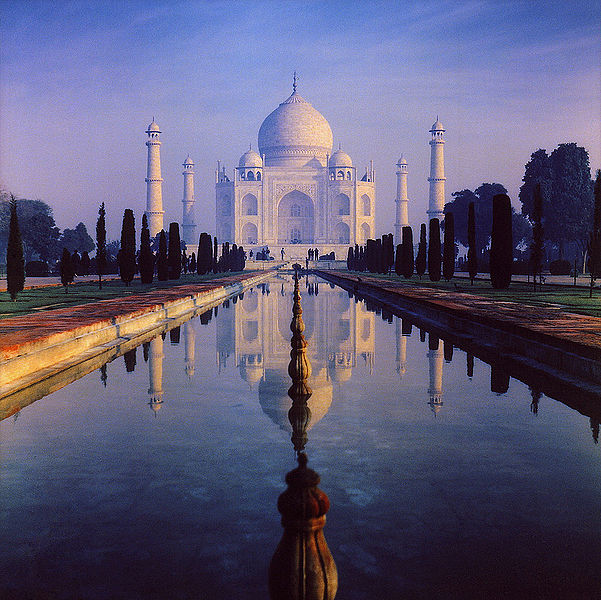
Considered to be an "unrivaled architectural wonder", the Taj Mahal in Agra is a prime example of Indo-Islamic architecture. One of the world's seven wonders.
Indian architecture encompasses a multitude of expressions over space and time, constantly absorbing new ideas. The result is an evolving range of architectural production that nonetheless retains a certain amount of continuity across history. Some of its earliest production are found in the Indus Valley Civilization (2600–1900 BC) which is characterised by well planned cities and houses. Religion and kingship do not seem to have played an important role in the planning and layout of these towns.
During the period of the Mauryan and Gupta empires and their successors, several Buddhist architectural complexes, such as the caves of Ajanta and Ellora and the monumental Sanchi Stupa were built. Later on, South India produced several Hindu temples like Chennakesava Temple at Belur, the Hoysaleswara Temple at Halebidu, and the Kesava Temple at Somanathapura, Brihadeeswara Temple, Thanjavur, the Sun Temple, Konark, Sri Ranganathaswamy Temple at Srirangam, and the Buddha stupa (Chinna Lanja dibba and Vikramarka kota dibba) at Bhattiprolu. Angkor Wat, Borobudur and other Buddhist and Hindu temples indicate strong Indian influence on South East Asian architecture, as they are built in styles almost identical to traditional Indian religious buildings.
The Umaid Bhawan Palace in Rajasthan, one of the largest private residences in the world.
The traditional system of Vaastu Shastra serves as India's version of Feng Shui, influencing town planning, architecture, and ergonomics. It is unclear which system is older, but they contain certain similarities. Feng Shui is more commonly used throughout the world. Though Vastu is conceptually similar to Feng Shui in that it also tries to harmonize the flow of energy, (also called life-force or Prana in Sanskrit and Chi/Ki in Chinese/Japanese), through the house, it differs in the details, such as the exact directions in which various objects, rooms, materials, etc. are to be placed..
With the advent of Islamic influence from the west, Indian architecture was adapted to allow the traditions of the new religion. Fatehpur Sikri, Taj Mahal, Gol Gumbaz, Qutub Minar, Red Fort of Delhi are creations of this era, and are often used as the stereotypical symbols of India. The colonial rule of the British Empire saw the development of Indo-Saracenic style, and mixing of several other styles, such as European Gothic. The Victoria Memorial or the Chhatrapati Shivaji Terminus are notable examples.
Indian architecture has influenced eastern and southeastern Asia, due to the spread of Buddhism. A number of Indian architectural features such as the temple mound or stupa, temple spire or sikhara, temple tower or pagoda and temple gate or torana, have become famous symbols of Asian culture, used extensively in East Asia and South East Asia. The central spire is also sometimes called a vimanam. The southern temple gate, or gopuram is noted for its intricacy and majesty.
Contemporary Indian architecture is more cosmopolitan. Cities are extremely compact and densely populated. Mumbai's Nariman Point is famous for its Art Deco buildings. Recent creations such as the Lotus Temple, and the various modern urban developments of India like Chandigarh, are notable.
Sports and Martial arts
Sports
Cricket was introduced to India by the British. Now it is the country's most popular sport.
The annual Snake boat race is performed during Onam Celebrations on the Pamba River at Aranmula near Pathanamthitta.
In 2011, India hosted its first Formula One Grand Prix event.
Yoga originated in India. Contrary to stereotypes, yoga is not about twisting into pretzel-like positions. Yoga is a means to reach balance in body, evenness of mind and a connection with spiritual self. Patañjali, in India's ancient books, suggests yoga's goal is to help one focus, reflect upon, know and express one's highest self. India's cultural journey with yoga is now popular in many parts of the world.
Main article: Sports in India
Field hockey is the official national sport in India, and the India national field hockey team won the 1975 Men's Hockey World Cup, and 8 gold, 1 silver, and 2 bronze medals at the Olympic Games.
Cricket is the most popular sport in India. The India national cricket team won the 1983 Cricket World Cup, the 2011 Cricket World Cup and the 2007 ICC World Twenty20, and shared the 2002 ICC Champions Trophy with Sri Lanka. Domestic competitions include the Ranji Trophy, the Duleep Trophy, the Deodhar Trophy, the Irani Trophy and the Challenger Series. In addition, BCCI conducts the Indian Premier League, a Twenty20 competition.
Chess is commonly believed to have originated in northwestern India during the Gupta empire, where its early form in the 6th century was known as chaturanga. Other games which originated in India and continue to remain popular in wide parts of northern India include Kabaddi, Gilli-danda, and Kho kho. Traditional southern Indian games include Snake boat race and Kuttiyum kolum.
In 2011, India inaugurated a privately built Buddh International Circuit, its first motor racing circuit. The 5.14 kilometer circuit is in Greater Noida, Uttar Pradesh, near Delhi. The first Formula One Indian Grand Prix event was hosted here in October 2011.Indian martial arts
Main article: Indian martial arts
Kalarippayattu, one of the oldest and most prominent forms of Indian martial arts.
One of the best known forms of ancient Indian martial arts is the Kalarippayattu from Kerala. This ancient fighting style originated in southern India in 12th century BC and is regarded as one of the oldest surviving martial arts. In this form martial arts, various stages of physical training include ayurvedic massage with sesame oil to impart suppleness to the body (uzichil); a series of sharp body movements so as to gain control over various parts of the body (miapayattu); and, complex sword fighting techniques (paliyankam). Silambam, which was developed around 200 AD, traces its roots to the Sangam period in southern India. Silambam is unique among Indian martial arts because it uses complex footwork techniques (kaaladi), including a variety of spinning styles. A bamboo staff is used as the main weapon. The ancient Tamil Sangam literature mentions that between 400 BC and 600 AD, soldiers from southern India received special martial arts training which revolved primarily around the use of spear (vel), sword (val) and shield (kedaham).
In northern India, the musti yuddha evolved in 1100 AD and focussed on mental, physical and spiritual training.
In addition, the Dhanur Veda tradition was an influential fighting arts style which considered the bow and the arrow to be the supreme weapons. The Dhanur Veda was first described in the 5th century BC Viṣṇu Purāṇa and is also mentioned in both of the major ancient Indian epics, the Rāmāyaṇa and Mahābhārata. A distinctive factor of Indian martial arts is the heavy emphasis laid on meditation (dhyāna) as a tool to remove fear, doubt and anxiety.
Indian martial arts techniques have had a profound impact on other martial arts styles across Asia. The 3rd century BC Yoga Sutras of Patanjali taught how to meditate single-mindedly on points located inside one's body, which was later used in martial arts, while various mudra finger movements were taught in Yogacara Buddhism. These elements of yoga, as well as finger movements in the nata dances, were later incorporated into various martial arts. According to some historical accounts, Indian Buddhist monk Bodhidharma was one of the main founders of the Shaolin Kungfu.
Popular media
Television
Main article: Television in India
See also: List of Indian television stations
Bollywood characters at International Indian Film Academy Awards, Toronto 2011
Indian television started off in 1959 in New Delhi with tests for educational telecasts. Indian small screen programming started off in the mid 1970s. At that time there was only one national channel Doordarshan, which was government owned. 1982 saw revolution in TV programming in India, with the New Delhi Asian games, India saw the colour version of TV, that year. The Ramayana and Mahabharat were some among the popular television series produced. By the late 1980s more and more people started to own television sets. Though there was a single channel, television programming had reached saturation. Hence the government opened up another channel which had part national programming and part regional. This channel was known as DD 2 later DD Metro. Both channels were broadcasted terrestrially.
In 1991, the government liberated its markets, opening them up to cable television. Since then, there has been a spurt in the number of channels available. Today, Indian silver screen is a huge industry by itself, and has thousands of programmes in all the states of India. The small screen has produced numerous celebrities of their own kind some even attaining national fame for themselves. TV soaps are extremely popular with housewives as well as working women, and even men of all kinds. Some lesser known actors have found success in Bollywood. Indian TV now has many of the same channels as Western TV, including stations such as Cartoon Network, Nickelodeon, HBO, FX, and MTV India.
Cinema
Main article: Cinema of India
Bollywood is the informal name given to the popular Mumbai-based film industry in India. Bollywood and the other major cinematic hubs (in Bengali, Kannada, Malayalam, Marathi, Tamil, Punjabi and Telugu) constitute the broader Indian film industry, whose output is considered to be the largest in the world in terms of number of films produced and number of tickets sold.
India has produced many critically acclaimed cinema-makers like K. Vishwanath, Bapu, Satyajit Ray, Ritwik Ghatak, Guru Dutt, K. Vishwanath, Adoor Gopalakrishnan, Shaji N. Karun, Girish Kasaravalli, Shekhar Kapoor, Hrishikesh Mukherjee, Shankar Nag, Girish Karnad, G. V. Iyer et al. (see Indian film directors). With the opening up of the economy in the recent years and consequent exposure to world cinema, audience tastes have been changing. In addition, multiplexes have mushroomed in most cities, changing the revenue patterns.
See also